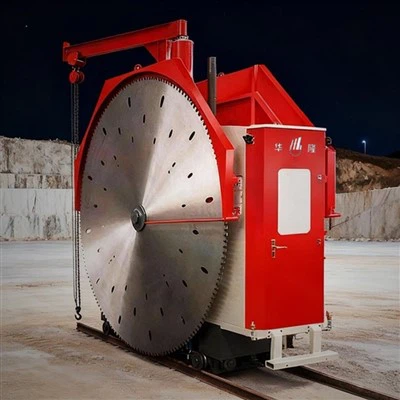
Stone processing machinery is the core equipment in the modern stone industry, enabling the transformation from raw stone blocks to finished products. Its working principle is based on mechanical transmission, cutting and grinding mechanisms, and automatic control technology. Through orderly power transmission and the coordination of actuators, it achieves efficient and precise processing of various types of stone. Understanding its principles helps to better utilize equipment efficiency and optimize process parameters in production.
Although various types of stone processing machinery differ in form and purpose, their basic working logic follows the path of "power supply-motion conversion-processing execution-process control." Power is usually provided by an electric motor, which, through a reducer, belt, or gear transmission system, is converted into the speed and torque required by the actuators. Sawing equipment uses high-speed rotating diamond saw blades or abrasive saw blades to apply shearing and grinding action to the stone through the saw teeth, causing the material to separate along a predetermined trajectory. The circumferential speed and feed rate of the saw blade must be matched according to the hardness and thickness of the material to ensure a smooth cut and reduce the risk of chipping.
The working principle of grinding and polishing equipment focuses on removing minute surface defects and improving surface finish. A motor drives a grinding disc or polishing pad to rotate or reciprocate. Under constant pressure, abrasive particles progressively cut the stone surface, gradually refining its roughness. Multi-stage grinding and polishing processes, through segmented control of particle size and pressure, achieve a continuous transition from coarse grinding to fine polishing, obtaining the desired gloss and texture.
Engraving and irregular-shaped cutting equipment often relies on a CNC system to control a multi-axis linkage mechanism, causing the tool or water jet to move along a digital model path. The CNC system converts the design graphics into pulse signals, driving servo or stepper motors to move the worktable or tool head to achieve complex trajectory processing, enabling fine operations such as relief carving, hollowing, and curved cutting. The core of this type of equipment lies in high-precision position feedback and real-time error compensation, ensuring the accuracy of complex surface reproduction.
In wet processing, cooling and dust removal systems operate simultaneously. Water pumps deliver coolant to the cutting or polishing area, reducing friction temperature and flushing away stone dust, preventing tool overheating and secondary dust contamination. A circulating filtration device ensures stable water quality, extends tool life, and improves the working environment.
Overall, the working principle of stone processing machinery is the result of a deep integration of mechanical mechanics, material removal mechanisms, and automatic control technology. The coordinated operation of each stage enables the equipment to not only meet the processing challenges of different rock types, but also to achieve a balance between precision, efficiency, and quality, providing a reliable guarantee for the high-quality output of stone products.