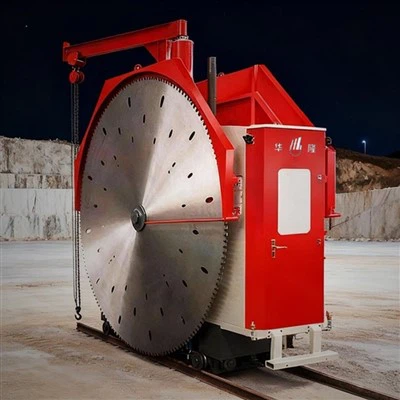
Bridge saws available on the market fall into two categories: conventional infrared manual bridge saws (equipped with frequency converter + control panel knobs) and CNC 4/5-axis bridge saws (speed regulated via touchscreen systems). Both rely on the spindle frequency converter to adjust motor speed. Never exceed the maximum RPM marked on the saw blade.
I. Three Speed Regulation Modes (Matching Different Machine Models)
Mode 1: Conventional Infrared Bridge Saw (External Potentiometer Knob, Most Common)
Safety Preparations: Shut down the machine, turn off the spindle, and wait until the saw blade stops completely before adjustment.
Locate the spindle speed adjustment knob on the operation console.
Make minor fine-tuning, test-cut after each ±100 RPM adjustment.
The knob only provides temporary adjustment. The factory-set maximum speed limit is locked inside the frequency converter; turning the knob all the way will not exceed the upper limit of the motor or saw blade.
Test-cut Criteria: Smooth cutting surface without edge chipping, severe vibration, and sufficient water cooling.
Mode 2: CNC Bridge Saw
Operation Steps
Power on and switch to Manual Mode; do not adjust speed during automatic cutting. (Operations vary slightly by machine brand and model)
Route 1: Spindle Interface → Spindle Speed S → Input target RPM and confirm activation.
Route 2: Spindle multiplier knob on the panel / multiplier slider on the screen. 100% stands for the base setting; real-time speed can be fine-tuned within 50%-120%.
Program Processing: Modify the S value in G-code (e.g. S2400, S3000), save the program and run it.
Speed Limit Lock: Set the maximum spindle speed in system parameters to prevent overspeed caused by misoperation.
Mode 3: Internal Parameter Adjustment via Frequency Converter
Only qualified electricians are allowed to operate this menu; it is unnecessary for daily cutting work.
Cut off power and open the electric control cabinet to access the spindle frequency converter (7.5/11/15kW as mainstream specifications).
Basic parameters (must match the motor nameplate): P01: Rated motor power, voltage, current, 50Hz, rated speed
Upper Limit Frequency P01.06: Controls maximum rotating speed. Standard setting for 350mm saw blades: 60–65Hz
Acceleration & Deceleration Time: 1–2 seconds to avoid tripping caused by startup/shutdown impact
Frequency-to-Speed Conversion (Universal for 350mm Saw Blades) 50Hz ≈ 2400RPM; 60Hz ≈ 2880RPM; 65Hz ≈ 3120RPM
Save parameters, power on and test run. Normal operation without abnormal noise or alarms indicates successful setup.
II. Standard Reference Speeds for Different Stone Materials (350mm / 14-inch Standard Saw Blade)
Critical Safety Rule: Under no circumstances exceed the maximum RPM stamped on the saw blade. Overspeeding may cause blade rupture and severe personal injury.
Marble / Limestone (Soft Stone): 2400–2800RPM Excessively high speed burns cutting segments and darkens slab surfaces; excessively low speed triggers edge chipping and heavy cutting resistance.
Granite / Grey Stone (Medium Hard Stone): 2800–3200RPM Optimal processing range delivering flat cutting surfaces and balanced segment wear.
Quartz Stone / Sintered Stone / Ultra-Hard Quartz: 1800–2200RPM These materials feature extreme hardness. High speed generates excessive heat that melts resin and accelerates segment abrasion. Low speed plus abundant water cooling is mandatory.
Thin Slabs (≤10mm): Increase speed by 200RPM based on the upper limit of corresponding material; Thick Slabs (≥50mm): Reduce speed by 200–400RPM.
III. Visual Judgment Criteria for Speed Adjustment
Signs of Excessively High Speed (Reduce Speed Immediately)
Darkened cutting kerf, burnt edges, whitened annealed cutting segments
Intense machine vibration and harsh noise
Heavy white mist from cooling water and sharp temperature rise
Rapid saw blade wear and diamond particle shedding
Signs of Excessively Low Speed (Increase Speed Gradually)
Heavy cutting resistance, machine stalling and slow feeding
Massive corner chipping and jagged rough edges on stone surfaces
Motor overload and frequent overcurrent alarms from the frequency converter
IV. Mandatory Safety Regulations
Always stop the machine before adjusting speed; keep hands away from rotating saw blades.
Run new saw blades at low speed for a 3-minute break-in period before raising to processing speed.
High-speed cutting is forbidden when cooling water supply is insufficient.
Speed must be readjusted when replacing saw blades of different diameters: Larger blades permit lower maximum speeds. Example: Max speed ≤2600RPM for 400mm blades; up to 3300RPM for 300mm blades.
Long-term operation below 1500RPM impairs spindle motor heat dissipation and may burn windings. Avoid prolonged low-speed cutting as much as possible.
V. Common Fault Troubleshooting
Speed remains unchanged after turning up the knob: The upper frequency limit of the frequency converter is locked. An electrician needs to adjust the maximum frequency via internal parameters.
Circuit trips immediately after speed increase: Too short acceleration/deceleration time, mismatched motor parameters, or heavy load due to insufficient cooling water.
Speed input on CNC touchscreen fails to take effect: Multiplier locked at 0%, spindle enable switch off, or emergency stop button pressed.
Vibration at low speed: Worn spindle bearings, deformed flange plate or warped saw blade. Prioritize mechanical inspection before adjusting speed.