Stone processing is a systematic engineering project integrating machinery, technology, and precision control. Its process flow relies on various specialized machines to unfold in an orderly manner, determining the dimensional accuracy, surface quality, and overall utilization rate of the finished product. In modern production, from the arrival of raw blocks to the delivery of finished products, each step is ensured by targeted equipment and standardized procedures.
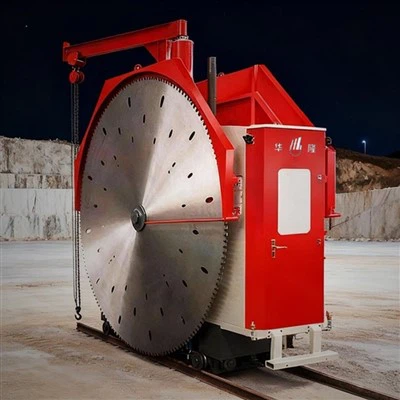
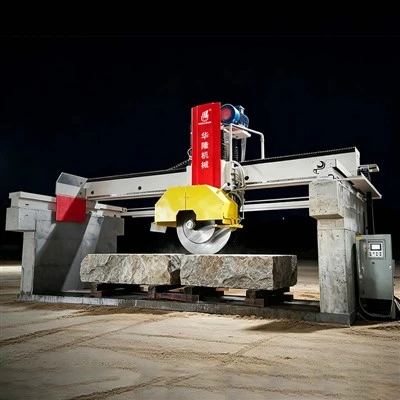
The process begins with raw block shaping. Large frame saws or circular saws cut the raw stone longitudinally or transversely according to preset dimensions, forming regular slabs or blocks. At this stage, the sawing path needs to be optimized based on the rock's hardness and grain direction to reduce the risk of edge chipping and internal cracking, while maximizing the yield. This is followed by a thickness setting process, where a thickness setting machine mills both sides of the slabs to achieve a uniform thickness standard, laying a smooth foundation for subsequent processing.
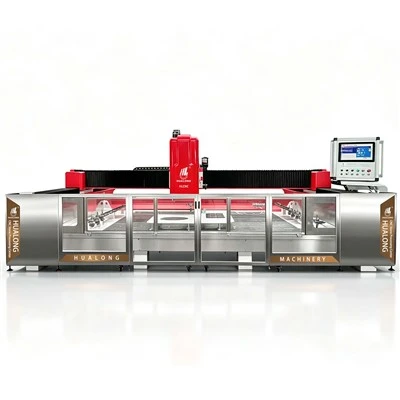
The surface finishing stage follows immediately. The coarse grinding machine first removes cutting marks and uneven layers, smoothing the surface. Fine grinding and polishing equipment progressively improve the finish, achieving a variety of effects from matte to mirror-like using different grit sizes and constant pressure control. During this process, cooling and dust removal systems operate simultaneously to ensure a clean processing area and extend the life of the grinding tools. For products requiring engraving or grooving, CNC engraving machines and contour cutting equipment perform precision operations according to design data, completing complex contours and three-dimensional shapes.
Irregular shape processing and splicing calibration are key to increasing the added value of the finished product. Waterjet cutting or CNC bridge cutting machines perform high-precision cutting of arcs, bevels, and inlay units, and repeated verification using positioning fixtures and measuring instruments ensures tight seams and overall harmony. The finished product inspection stage comprehensively evaluates dimensional tolerances, surface defects, and strength indicators. Qualified products enter a protection and packaging process to prevent contamination and damage during transportation and installation.
The entire process demonstrates a deep integration of mechanization, standardization, and information technology. Optimization of equipment linkage and process coordination not only shortens the production cycle but also significantly reduces raw material waste and rework rates. Looking to the future, with the introduction of intelligent sensing and data traceability systems, the stone processing flow will become more transparent and controllable, helping the industry to continuously improve in both quality and efficiency.