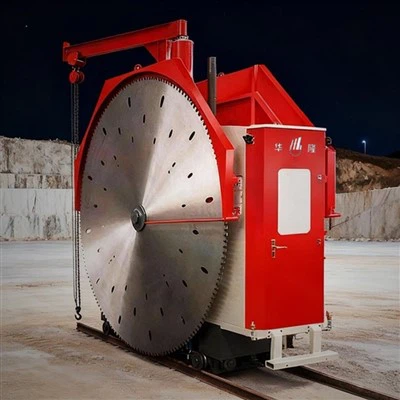
As the stone industry accelerates its move towards high-precision, high-efficiency, and green manufacturing, the design philosophy of stone processing machinery has shifted from simply pursuing processing capacity to a systematic approach that integrates process requirements, human-machine collaboration, and ecological benefits. Excellent design not only determines the upper limit of equipment performance but also directly impacts the stability of the production process and industrial competitiveness.
Design must first adhere to the principle of process adaptability. The diverse types of stone, with significant differences in hardness, texture, and brittleness/ductility, require machinery to be precisely matched to different processing scenarios in terms of structural layout, power configuration, and actuator selection. For example, sawing equipment needs to optimize the relationship between saw blade diameter and feed rate based on lithology, while grinding equipment should achieve uniform pressure on curved surfaces through multi-axis linkage to ensure processing consistency and surface quality. Designers must conduct thorough research on production line requirements in the early stages to ensure close coupling between mechanical functions and process nodes, reducing adaptation losses during process transitions.
Rigidity and stability are core design considerations. Stone processing involves high-frequency impacts and continuous loads. Insufficient structural rigidity can easily lead to vibration and displacement, affecting accuracy and accelerating component wear. Modern designs commonly employ finite element analysis to optimize the frame and guide rail layout, combined with high-rigidity materials and vibration damping measures to construct a stable processing platform. Simultaneously, modular design is widely adopted, allowing key units such as the spindle and feed system to be replaced or upgraded as needed, extending the overall machine lifespan and reducing maintenance complexity.
Human-machine interaction and intelligent integration constitute a new dimension of contemporary design. A well-designed human-machine interface should be intuitive and simple, facilitating quick parameter setting and status monitoring by operators. Automated auxiliary functions such as automatic tool setting, anomaly alarms, and data traceability minimize human intervention and improve the reliability of continuous operation. Some designs reserve IoT interfaces to support remote diagnostics and production line collaboration, laying the foundation for smart factory construction.
Environmental protection and energy conservation concepts also profoundly influence design orientation. Optimizing transmission paths to reduce unnecessary power consumption, introducing wet circulation and dust collection systems to reduce environmental impact, and using recyclable materials to manufacture structural components all reflect a conscious commitment to green design. Such measures not only align with industrial policy guidelines but also translate into significant cost advantages in the long run.
Overall, the design philosophy of stone processing machinery is evolving towards a multi-objective balance-integrating intelligent, modular, and sustainable elements while ensuring process precision and operational reliability, providing a solid technological foundation for the industry's high-quality development.