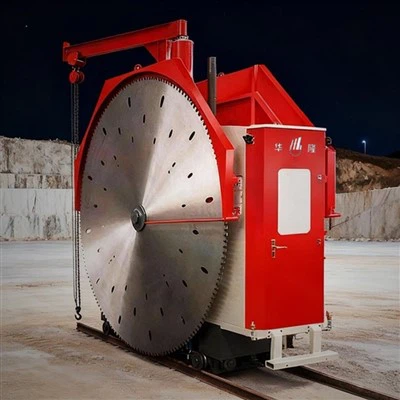
As a crucial source of stone and other building materials, the production efficiency and resource utilization level of quarries largely depend on the performance and configuration of their machinery and equipment.Quarry machinery covers the entire process from post-blasting block extraction, stripping, crushing, screening to primary transportation, undertaking the core task of transforming natural rock masses into usable raw materials. In modern mining production, this type of machinery not only requires powerful operational capabilities but also must meet increasingly stringent industry standards in terms of safety, environmental protection, and energy efficiency.
Open-pit quarrying operations typically begin with stripping and extraction equipment. Excavators and hydraulic hammers can quickly clear and break down overburden and larger boulders, creating working faces for subsequent crushing processes. Wheeled or tracked loaders offer flexible mobility, enabling the rapid stockpiling or loading of loose stones into transport vehicles, shortening cycle time and improving loading efficiency. In mining areas with complex terrain or limited space, the application of miniaturized, multi-functional machinery can significantly reduce reliance on roads and work platforms.
The crushing and screening stages are the technological core of the quarry machinery chain. Jaw crushers, cone crushers, and impact crushers are used in combination based on the hardness of the raw materials and the required particle size of the product, enabling continuous processing from coarse to medium and fine crushing. Screening equipment uses screens of different apertures to classify the crushed products, meeting the differentiated specifications of concrete aggregates, road base materials, and decorative stone blocks. Modern crushing and screening units often incorporate intelligent monitoring systems to collect real-time load, temperature, and vibration data, automatically adjusting feeding and discharge speeds to maintain efficient and stable equipment operation.
The transportation system plays a crucial role in the quarry's machinery system, ensuring material flow and continuous operation. Mining trucks, belt conveyors, and rail transport equipment each have their advantages: trucks are flexible and adaptable to various routes, conveyors are suitable for long-distance, high-volume continuous transport, and rail systems provide low-energy, high-stability transport on fixed lines. A reasonable combination of transportation methods can reduce the number of transfers and material segregation, lowering energy consumption and equipment wear.
Safety and environmental performance have become important considerations in the design and selection of quarry machinery. Equipment must possess reliable braking, anti-tipping, and dust and noise reduction measures to ensure the safety of workers and the surrounding environment. Wet dust suppression, closed conveying, and noise isolation technologies can effectively control dust diffusion and noise pollution, meeting the requirements of green mine construction. Furthermore, some machinery has achieved energy-saving optimization of the power system and long-life design of components, reducing the total life-cycle operating cost.
Overall, quarry machinery, through efficient stripping, precise crushing, scientific screening, and smooth transfer, constructs a systematic production chain from rock mass to raw materials. With the integration of automation and information technology, its enhanced capabilities in remote control, status monitoring, and intelligent scheduling will further propel the quarry industry towards safety, efficiency, and green practices, providing a solid resource guarantee for infrastructure construction and the building materials industry.