The waterjet process is an advanced processing method that uses a high-pressure liquid as a medium. Through a special nozzle, water is accelerated to extremely high speeds to form a high-energy jet, which is then used for material processing, surface treatment, or cleaning by utilizing its impact force and cutting action. This method centers on controllable water kinetic energy and mechanical effects, integrating technologies such as pressure generation, parameter adjustment, and path control to form a systematic operating system applicable to various materials, shapes, and environments.
The primary steps in the waterjet process are high-pressure generation and jet formation. Water is pressurized to hundreds of megapascals using a plunger pump or centrifugal pump set. After being stabilized by an energy storage device, it is transported along a pressure-resistant pipeline to a precision-manufactured nozzle. Constrained by the nozzle's extremely small orifice, the water pressure energy is converted into kinetic energy, causing the jet velocity to reach several times the speed of sound, forming a small-diameter, energy-concentrated jet. Pure water jetting is suitable for softer or heat-sensitive materials, while abrasive water jetting mixes hard particles such as garnet and corundum into the water. Through the synergistic effect of water jet impact and abrasive cutting, it can efficiently process hard substrates such as metals, stone, ceramics, and composite materials.
In terms of its mechanism, water jetting relies on the dynamic pressure and shear effect of high-speed fluid to remove material. When the jet impacts the workpiece surface, it instantly generates a huge impact force, causing plastic deformation, crack propagation, and localized spalling of the material. The embedding and impact of abrasive particles further enhance the cutting ability, achieving precise separation of hard materials. Because the entire process is a cold process with no high-temperature heat input, it avoids metallographic changes, thermal stress cracks, or edge melting caused by traditional thermal cutting, making it particularly suitable for heat-sensitive or easily deformable workpieces.
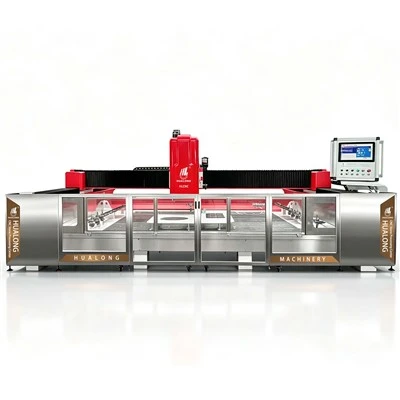
Parameter control in water jetting is key to achieving process precision. Parameters such as pressure, flow rate, target distance, nozzle diameter, and abrasive type and concentration can be flexibly matched according to the processing purpose: high pressure and high flow rate are suitable for large-area peeling and rapid cutting; lower pressure and small nozzles combined with fine paths can achieve micron-level precision engraving and drilling. The introduction of CNC systems and multi-axis platforms allows the jet to move along a preset trajectory, completing two-dimensional cutting, three-dimensional shaping, and complex contour processing, significantly improving automation and repeatability.
In terms of application methods, waterjet can cover a variety of processes such as cutting, drilling, milling, engraving, paint removal, rust removal, descaling, and surface roughening. In metal processing, it is used for thick plate cutting and cavity forming; in the stone industry, for pattern engraving and irregular shape cutting; in the aerospace field, for composite material component repair; in ship and bridge maintenance, for anti-corrosion layer removal and surface pretreatment; and in municipal engineering, for road marking removal and concrete surface repair. Its cold-state, flexible, and environmentally friendly characteristics make it particularly advantageous in flammable and explosive environments, environments requiring high cleanliness, or environments where heat effects must be avoided.
In summary, the waterjet method, with high-pressure and high-speed fluid as its core, constructs a process platform that combines versatility, precision, and environmental friendliness through a scientific parameter system and CNC execution. This provides a practical, efficient, safe, and highly adaptable technical approach for modern manufacturing and maintenance engineering.