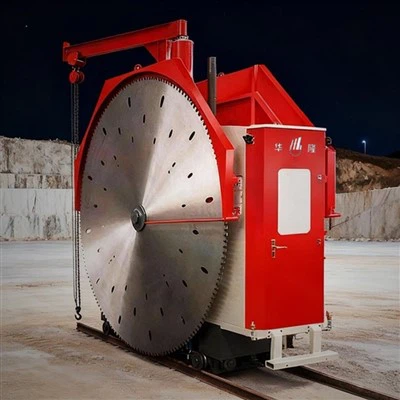
The overall performance and operational reliability of stone processing machinery stem from the organic combination and rational configuration of its internal functional units.The composition method not only reflects the logicality of the mechanical structure but also directly affects processing accuracy, operational stability, and ease of maintenance. During the design and manufacturing process, the entire machine is typically divided into several functional modules based on process requirements, forming a complete processing system through scientific connection and coordination.
The main support structure is the foundation of the composition, generally including the bed, crossbeam, column, and work platform. These components are mostly made of cast iron or welded steel structures, bearing the weight of the entire machine and various static and dynamic loads during processing. Their geometric accuracy and rigidity determine the equipment's vibration resistance under high-speed, heavy-load conditions, a prerequisite for ensuring processing stability. The layout of the support structure must consider the movement space and force transmission path of each actuator, reducing the accumulation of errors caused by deformation or displacement.
The power and transmission system is the energy source and distribution hub of the machinery. The electric motor provides the initial driving force, which is converted into speeds and torques suitable for different actuators through reducers, couplings, belts, or gear sets. The transmission system of sawing equipment must ensure stable output at high spindle speeds, while grinding and polishing equipment emphasizes continuous torque control. Engraving and CNC equipment require transmission chains with high-resolution position feedback capabilities. During material selection and assembly, the clearance and coaxiality of each transmission component must be strictly controlled to reduce energy loss and improve response accuracy.
The actuator is the working unit that directly acts on the stone, including the saw blade clamping and drive assembly, the grinding disc and polishing pad drive unit, and the CNC tool or water jet nozzle movement mechanism. Depending on the process type and the object being processed, they may have rotation, oscillation, translation, or multi-axis linkage functions. The design of the actuator must match the processing force and motion trajectory requirements, while also being structurally easy to replace and calibrate to adapt to diverse production needs.
The control system and sensor monitoring unit constitute the "nerve center" of the machine. The CNC system receives and processes the machining program instructions, converting them into drive signals for servo or stepper motors to achieve precise trajectory and speed control. Matching displacement, force, temperature, and vibration sensors can monitor the operating status in real time, providing a basis for closed-loop control and anomaly warning. Modern equipment often integrates human-machine interfaces, data storage, and remote communication functions into the control system, improving operational convenience and information transparency.
Auxiliary systems include cooling, lubrication, dust removal, and safety protection devices. The cooling system reduces the temperature of the cutting tools and workpieces through liquid circulation, minimizing thermal deformation and wear; the lubrication system supplies lubricant to key components at regular intervals and in measured quantities, extending the life of moving parts; the dust removal system captures stone dust and purifies emissions, improving the working environment; and safety protection devices ensure the safety of personnel and equipment through limit switches, emergency stops, and interlocking mechanisms.
In summary, the modular approach to stone processing machinery integrates five major functional systems-support, power, execution, control, and auxiliary-through precise coordination and system integration, achieving efficient processing from raw materials to finished products. This structured approach provides a solid foundation for equipment performance optimization, flexible expansion, and subsequent maintenance, and also promotes the steady progress of stone processing towards intelligence and standardization.